


Privacy Policy
Introduction
With the following privacy policy, we would like to inform you about the types of your personal data (hereinafter also referred to as "data") that we process, for what purposes, and to what extent. This privacy policy applies to all processing of personal data carried out by us, both in the context of providing our services and, in particular, on our websites, in mobile applications, and within external online presences, such as our social media profiles (hereinafter collectively referred to as "online services").
The terms used are not gender-specific.
Table of Contents
- Introduction
- Responsible
- Overview of processing activities
- Relevant legal bases
- Security measures
- Transmission and disclosure of personal data
- Data processing in third countries
- Commercial and business services
- Provision of the online service and web hosting
- Contact
- Deletion of data
- Changes and updates to the privacy policy
- Rights of data subjects
- Definitions of terms
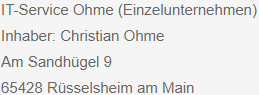
Responsible
E-Mail: info@localhost:3000
Overview of processing activities
The following overview summarizes the types of data processed and the purposes of their processing, and refers to the data subjects.
Types of data processed
- Inventory data (e.g. names, addresses).
- Content data (e.g., entries in online forms).
- Contact details (e.g. email, phone numbers).
- Metadata/communication data (e.g., device information, IP addresses).
- Usage data (e.g. websites visited, interest in content, access times).
- Contract details (e.g. subject matter of the contract, term, customer category).
- Payment details (e.g. bank details, invoices, payment history).
Categories of affected persons
- Business and contractual partners.
- Interested parties.
- Communication partner.
- Users (e.g., website visitors, users of online services).
Purposes of processing
- Office and organizational procedures.
- Contact requests and communication.
- Provision of contractual services and customer service.
- Managing and responding to inquiries.
Relevant legal bases
Below, we explain the legal bases under the General Data Protection Regulation (GDPR) on which we process personal data. Please note that in addition to the GDPR, national data protection regulations may apply in your or our country of residence or establishment. If more specific legal bases apply in individual cases, we will inform you of these in the privacy policy.
- Contractual performance and pre-contractual inquiries (Art. 6 para. 1 sentence 1 lit. b. GDPR) - The processing is necessary for the performance of a contract to which the data subject is a party or in order to take steps at the request of the data subject prior to entering into a contract.
- Legal obligation (Art. 6 para. 1 sentence 1 lit. c. GDPR) - The processing is necessary for compliance with a legal obligation to which the controller is subject.
- Legitimate interests (Art. 6 para. 1 sentence 1 lit. f. GDPR) - Processing is necessary for the purposes of the legitimate interests pursued by the controller or by a third party, except where such interests are overridden by the interests or fundamental rights and freedoms of the data subject which require protection of personal data.
Security measures
In accordance with legal requirements, taking into account the state of the art, the costs of implementation and the nature, scope, context and purposes of processing as well as the varying likelihood and severity of the threat to the rights and freedoms of natural persons, we implement appropriate technical and organizational measures to ensure a level of security appropriate to the risk.
These measures include, in particular, ensuring the confidentiality, integrity, and availability of data by controlling physical and electronic access to the data, as well as access to, input of, transfer of, and ensuring the availability and separation of the data. Furthermore, we have established procedures that guarantee the exercise of data subject rights, the deletion of data, and responses to data breaches. We also consider the protection of personal data during the development and selection of hardware, software, and processes, in accordance with the principles of data protection by design and by default.
Transmission and disclosure of personal data
As part of our processing of personal data, it may be necessary to transfer or disclose data to other entities, companies, legally independent organizational units, or individuals. Recipients of this data may include, for example, payment institutions involved in payment transactions, IT service providers, or providers of services and content integrated into a website. In such cases, we comply with legal requirements and, in particular, conclude appropriate contracts or agreements with the recipients of your data to protect your data.
Data processing in third countries
If we process data in a third country (i.e., outside the European Union (EU), the European Economic Area (EEA)) or if the processing takes place in the context of using third-party services or disclosing or transferring data to other persons, bodies or companies, this will only be done in accordance with legal requirements.
Subject to explicit consent or where transfer is required by contract or law, we only process or have data processed in third countries with a recognized level of data protection, contractual obligations through so-called standard contractual clauses of the EU Commission, in the presence of certifications or binding internal data protection regulations (Articles 44 to 49 GDPR, information page of the EU Commission: https://ec.europa.eu/info/law/law-topic/data-protection/international-dimension-data-protection_de ).
Commercial and business services
We process data of our contractual and business partners, e.g. customers and prospective customers (collectively referred to as "contractual partners") within the framework of contractual and similar legal relationships as well as related measures and in the context of communication with the contractual partners (or pre-contractually), e.g. to answer inquiries.
We process this data to fulfill our contractual obligations, to safeguard our rights, and for the administrative tasks and business organization associated with this information. We only disclose the data of our contractual partners to third parties within the framework of applicable law to the extent necessary for the aforementioned purposes, to fulfill legal obligations, or with the consent of the data subjects (e.g., to participating telecommunications, transport, and other support services, as well as subcontractors, banks, tax and legal advisors, payment service providers, or tax authorities). Contractual partners will be informed about further forms of processing, e.g., for marketing purposes, within the framework of this privacy policy.
We will inform our contractual partners which data is required for the aforementioned purposes before or during data collection, e.g. in online forms, by means of special markings (e.g. colors) or symbols (e.g. stars or similar), or personally.
We delete data after the expiry of statutory warranty periods and similar obligations, i.e., generally after 4 years, unless the data is stored in a customer account, e.g., as long as it must be retained for legal reasons (e.g., for tax purposes, generally 10 years). Data disclosed to us by the contractual partner within the scope of a contract is deleted according to the contract specifications, generally after the contract has ended.
Insofar as we use third-party providers or platforms to provide our services, the terms and conditions and privacy policies of the respective third-party providers or platforms apply to the relationship between users and the providers.
Agency services : We process our clients' data within the scope of our contractual services, which may include, for example, conceptual and strategic consulting, campaign planning, software and design development/consulting or maintenance, implementation of campaigns and processes, handling, server administration, data analysis/consulting services and training services.
- Types of data processed: Inventory data (e.g. names, addresses), payment data (e.g. bank details, invoices, payment history), contact data (e.g. email, telephone numbers), contract data (e.g. subject of contract, term, customer category).
- Affected persons: prospective customers, business partners and contractual partners.
- Purposes of processing: Provision of contractual services and customer service, contact requests and communication, office and organizational procedures, administration and answering of inquiries.
- Legal basis: Contract performance and pre-contractual inquiries (Art. 6 para. 1 sentence 1 lit. b. GDPR), Legal obligation (Art. 6 para. 1 sentence 1 lit. c. GDPR), Legitimate interests (Art. 6 para. 1 sentence 1 lit. f. GDPR).
Provision of the online service and web hosting
To ensure the secure and efficient provision of our online services, we utilize the services of one or more web hosting providers, from whose servers (or servers they manage) the online services can be accessed. For these purposes, we may utilize infrastructure and platform services, computing capacity, storage space and database services, as well as security and technical maintenance services.
The data processed in connection with providing our hosting services may include all information relating to users of our online services that is generated during use and communication. This regularly includes the IP address, which is necessary to deliver the content of online services to browsers, and all entries made within our online services or on websites.
Email sending and hosting : The web hosting services we use also include sending, receiving, and storing emails. For these purposes, the addresses of the recipients and senders, as well as other information relating to email transmission (e.g., the providers involved) and the content of the respective emails, are processed. The aforementioned data may also be processed for spam detection purposes. Please note that emails are generally not encrypted when sent over the internet. While emails are usually encrypted during transmission, they are not encrypted on the servers from which they are sent and received (unless end-to-end encryption is used). Therefore, we cannot assume any responsibility for the security of emails during transmission between the sender and their arrival on our server.
Collection of access data and log files : We (or our web hosting provider) collect data on every access to the server (so-called server log files). Server log files may include the address and name of the accessed web pages and files, the date and time of access, the amount of data transferred, notification of successful access, browser type and version, the user's operating system, referrer URL (the previously visited page), and, typically, IP addresses and the requesting provider.
Server log files can be used for security purposes, e.g., to avoid overloading the servers (especially in the case of malicious attacks, so-called DDoS attacks), and to ensure server utilization and stability.
- Types of data processed: Content data (e.g. entries in online forms), usage data (e.g. websites visited, interest in content, access times), meta/communication data (e.g. device information, IP addresses).
- Affected persons: Users (e.g., website visitors, users of online services).
- Legal basis: Legitimate interests (Art. 6 para. 1 sentence 1 lit. f. GDPR).
Contact
When you contact us (e.g. via contact form, email, telephone or social media), the information provided by the requesting persons will be processed to the extent necessary to answer the contact requests and any requested measures.
Responding to contact requests within the framework of contractual or pre-contractual relationships is done to fulfill our contractual obligations or to answer (pre-)contractual inquiries, and otherwise on the basis of our legitimate interests in answering the inquiries.
- Types of data processed: Inventory data (e.g. names, addresses), contact data (e.g. email, telephone numbers), content data (e.g. entries in online forms).
- Affected persons: Communication partners.
- Purposes of processing: Contact requests and communication.
- Legal basis: Contract performance and pre-contractual inquiries (Art. 6 para. 1 sentence 1 lit. b. GDPR), Legitimate interests (Art. 6 para. 1 sentence 1 lit. f. GDPR).
Deletion of data
The data we process will be deleted in accordance with legal requirements as soon as the consents allowing its processing are revoked or other permissions cease to apply (e.g., if the purpose of processing this data no longer exists or it is no longer necessary for that purpose).
Unless the data is deleted because it is required for other legally permissible purposes, its processing will be restricted to those purposes. This means the data will be blocked and not processed for any other purpose. This applies, for example, to data that must be retained for commercial or tax law reasons, or whose storage is necessary for the establishment, exercise, or defense of legal claims, or for the protection of the rights of another natural or legal person.
Further information regarding the deletion of personal data can also be found in the individual data protection notices of this privacy policy.
Changes and updates to the privacy policy
We ask that you regularly review the content of our privacy policy. We will update the privacy policy as soon as changes to our data processing activities make this necessary. We will inform you if any changes require action on your part (e.g., consent) or any other individual notification.
If we provide addresses and contact information for companies and organizations in this privacy policy, please note that the addresses may change over time and ask you to check the information before contacting them.
Rights of data subjects
As a data subject, you have various rights under the GDPR, which arise in particular from Articles 15 to 21 GDPR:
- Right to object: You have the right to object, on grounds relating to your particular situation, at any time to processing of personal data concerning you which is based on point (e) or (f) of Article 6(1) of the GDPR, including profiling based on those provisions. Where personal data concerning you are processed for direct marketing purposes, you have the right to object at any time to processing of personal data concerning you for such marketing, which includes profiling to the extent that it is related to such direct marketing.
- Right of withdrawal for consents: You have the right to withdraw any consent you have given at any time.
- Right to information: You have the right to request confirmation as to whether data concerning you is being processed, and to access this data as well as further information and a copy of the data in accordance with legal requirements.
- Right to rectification: In accordance with legal requirements, you have the right to request the completion of your personal data or the correction of inaccurate personal data concerning you.
- Right to erasure and restriction of processing: In accordance with legal requirements, you have the right to request that data concerning you be erased without undue delay, or alternatively, in accordance with legal requirements, to request a restriction of the processing of the data.
- Right to data portability: You have the right to receive the personal data concerning you that you have provided to us in a structured, commonly used and machine-readable format, or to request its transmission to another controller, in accordance with the legal requirements.
- Right to lodge a complaint with a supervisory authority: You also have the right, in accordance with legal requirements, to lodge a complaint with a supervisory authority, in particular in the Member State of your habitual residence, your place of work or the place of the alleged infringement, if you believe that the processing of personal data relating to you infringes the GDPR.
Definitions of terms
This section provides an overview of the terms used in this privacy policy. Many of the terms are taken from the law and are defined primarily in Article 4 of the GDPR. The legal definitions are binding. The following explanations, however, are intended primarily to aid understanding. The terms are listed alphabetically.
- Personal data: "Personal data" means any information relating to an identified or identifiable natural person (hereinafter referred to as "data subject"); an identifiable natural person is one who can be identified, directly or indirectly, in particular by reference to an identifier such as a name, an identification number, location data, an online identifier (e.g. a cookie) or to one or more factors specific to the physical, physiological, genetic, mental, economic, cultural or social identity of that natural person.
- Controller: The term "controller" refers to the natural or legal person, public authority, agency or other body which, alone or jointly with others, determines the purposes and means of the processing of personal data.
- Processing: "Processing" means any operation or set of operations which is performed on personal data or on sets of personal data, whether or not by automated means. The term is broad and encompasses virtually any handling of data, be it collection, analysis, storage, transmission, or erasure.
Created with the free data privacy generator Datenschutz-Generator.de by Dr. Thomas Schwenke